
This report provides an overview of an individual's personality based on behavioral analysis and soft skills — not based on work experience, technical skills, or personal interests.
This type of report is designed to support the initial scanning or screening process, particularly in recruitment or early-stage candidate evaluation.
It is important to understand that:
This report is not a final decision-making tool
It should not be used as the sole basis for hiring or promotion decisions
It is not comprehensive enough to conclude overall competency
Its function is to provide an initial overview so that we can determine:
Who should be prioritized for an interview
Which areas need deeper exploration
What potential blind spots should be considered
The main principle remains one thing:
This report covers 7 key areas:
Emotional Quotient (EQ)
Adversity Quotient (AQ)
Creative Quotient (CQ)
Self-Awareness
Collaboration
Overall Personality
Dominant Work Motivation
Each aspect is displayed on a color scale ranging from:

The further to the right, the stronger the potential. And the further to the left, the weaker the potential.
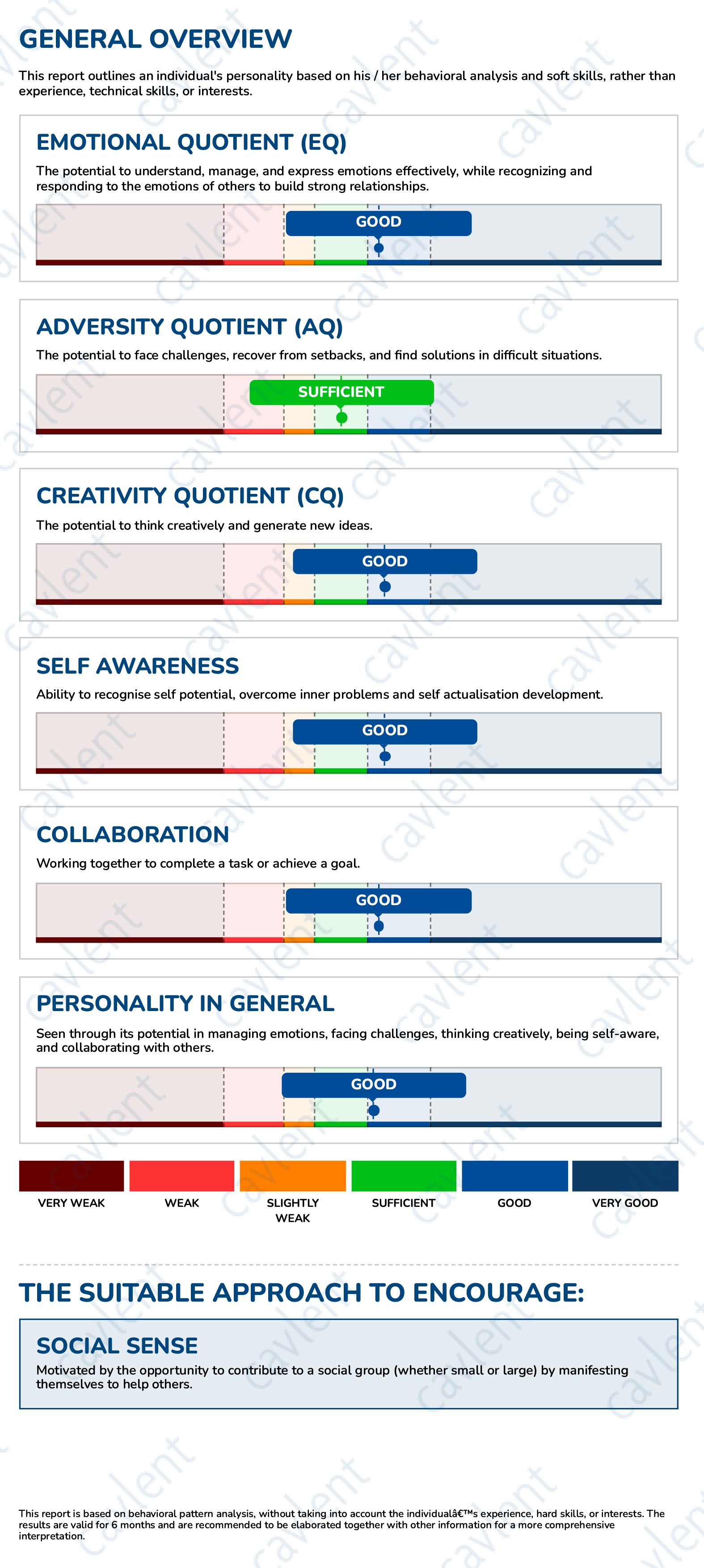
Emotional Intelligence (EQ)
EQ refers to the potential to:
In simple terms, EQ reflects emotional maturity.
In a Recruitment Context
If the organization prioritizes attitude and personality, EQ becomes an important factor. However, it is still necessary to consider:
Adversity Quotient (AQ)
AQ refers to the potential to face challenges, recover from difficulties, and seek solutions in tough situations.
Strategic Note
A team composed entirely of individuals with very high AQ may become overly ambitious or rigid. Combining them with individuals who have more moderate AQ can help create cultural balance and broader perspectives.
Creative Quotient (CQ)
CQ refers to the potential to think creatively and generate new ideas.
Relevance depends heavily on the role:
What matters is not whether it is “good or bad,” but whether it fits the role’s needs.
Self-Awareness
Self-awareness refers to the ability to recognize one’s strengths and weaknesses, address internal challenges, and engage in personal development.
If Tends to Be High:
If Tends to Be Low:
Within an organization, a diversity of self-awareness levels within a team can create healthy dynamics between caution and exploration.
Collaboration
Collaboration refers to the potential to work effectively with others toward shared goals.
This should always be aligned with role requirements.
Overall Personality
This section provides a general overview based on:
It offers a global signal rather than an absolute judgment.
The Right Approach to Motivation
This report also displays one dominant motivation. Although every individual has five types of motivation, the scanning report highlights only the strongest one at the moment.
Acknowledgement
Individuals with this motivation tend to require public acknowledgment of their achievements. This may include:
To maximize motivation, they need clear exposure and acknowledgment of their contributions. If the approach is incorrect (for example, only providing private appreciation), their motivation may not be fully activated.
Satisfaction
Individuals with this motivation tend to require public acknowledgment of their achievements. This may includeThis motivation appears when individuals enjoy challenges. The more challenging the work, the more energized they feel. If the work becomes monotonous and repetitive, they may quickly feel bored and their performance may decline. To optimize this motivation:
Appreciation
Unlike public recognition, appreciation is personal and private. It may include:
These individuals feel highly valued through warm and personal acknowledgment.
Rewards and Benefits
This motivation is transactional in nature. As long as the effort given is proportional to the benefits received, the individual will remain motivated. Best approaches include:
Without clarity in return, motivation for this type may decline.
Social Sense
This motivation emerges when individuals feel their contributions positively impact a meaningful social group. This group may include:
Effective approaches include:
The Screening Report is not a tool for judgment or final conclusions. It is a supporting tool for:
Use this report objectively, proportionally, and based on relevance to organizational needs.
With proper understanding, this report can become a highly effective tool for early-stage screening and more strategic human resource management.
For decision-makers prioritizing speed and precision, Cavlent is a transformation navigator offering behavior-based team mapping. We identify soft skill mismatches and hidden risks in team dynamics through same-day insights, compared to traditional methods that are time-consuming and rely on manual processes.
For more information, contact: